
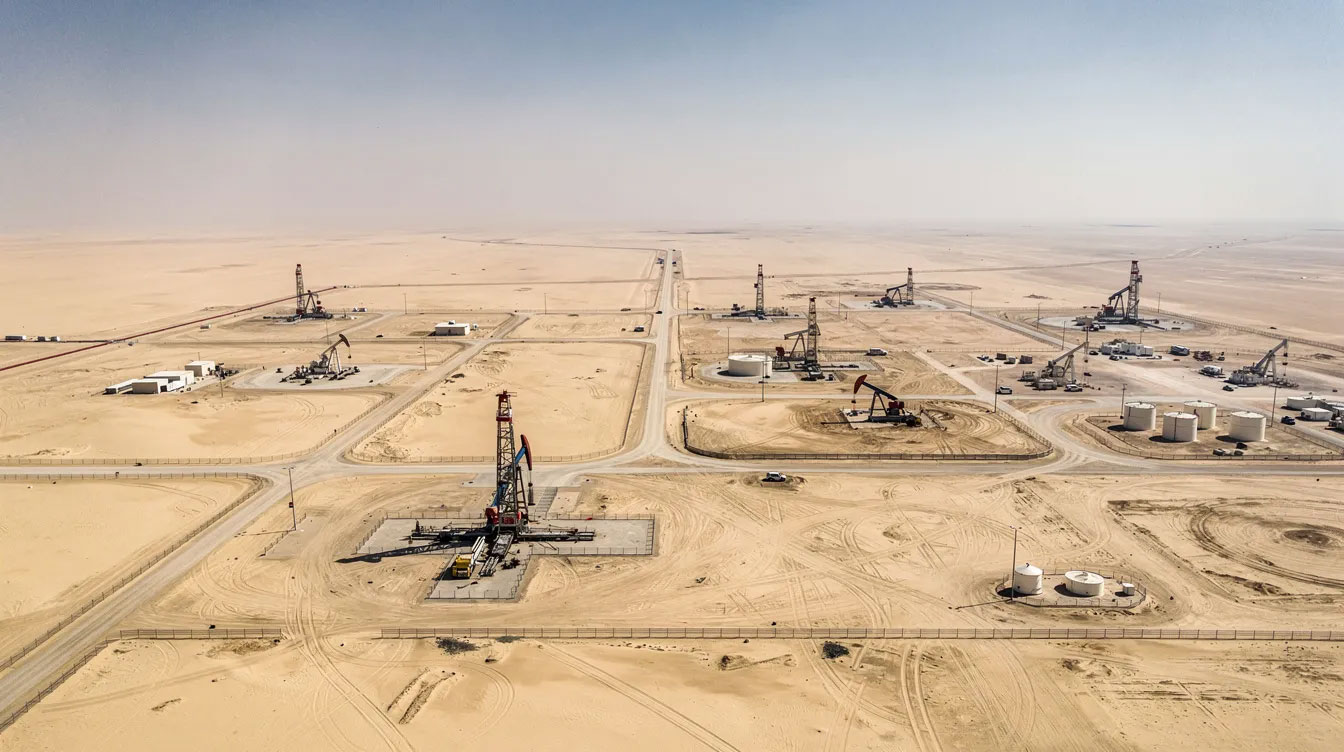
Oil reserves shape energy prices, national power, and long-term investment decisions. But the countries with the world’s largest oil reserves are not always the countries producing the most oil today.
Key Takeaways
- Venezuela has the largest proven oil reserves at 303 billion barrels, followed by Saudi Arabia with 267 billion barrels and Iran with 208.6 billion barrels.
- Global oil reserves are concentrated in a small group of countries, especially in the Middle East and the Americas.
- Proven oil reserves represent oil that can be commercially recovered under current conditions, but geology, cost, sanctions, and politics affect production.
- OPEC members control 60% of the world’s oil reserves, giving those nations major influence over global energy markets.
- Domestic Drilling and Operating focuses on U.S. oil and gas projects with proven reserves, helping qualified investors participate directly in current drilling and development opportunities.
What Are Oil Reserves and Why They Matter
Crude oil is a naturally occurring liquid hydrocarbon found underground in rock formations. Oil reserves are the estimated volumes of oil that can be extracted from those formations using available technology and under current economic conditions.
Proven reserves represent oil that can be commercially recovered under current conditions. In practice, that means the oil is not just believed to exist; it must be technically recoverable, economically viable, and supported by engineering and geological analysis.
Oil reserves are categorized based on the likelihood of recovery and economic viability. Proven reserves have the highest confidence. Unproven reserves are classified as probable or possible and require further exploration. Geologists estimate oil volumes by analyzing core samples and seismic surveys, then engineers model how much can realistically be produced.
There are also different classes of resources. Conventional crude oil may flow more easily from reservoirs, while unconventional resources such as oil sands, heavy oil, bitumen, and shale often require more complex extraction methods, including thermal recovery, upgrading, or fracking.
For governments, reserves create national leverage. Countries with large oil reserves gain significant geopolitical power because oil supports trade, fuel security, military readiness, manufacturing, and public revenue. For investors, proven reserves matter because barrels in the ground can become production, cash flow, and asset value, especially for those seeking energy sector diversification and inflation-hedging income through oil and gas investments.
Global Oil Reserves at a Glance
The world has roughly 1.5 trillion to 1.6 trillion barrels of global oil reserves, depending on the source and different definitions used. The OPEC Annual Statistical Bulletin and other industry sources update these figures regularly.
A small number of countries hold the majority of the world’s proven oil reserves. The production decisions of top reserve holders dictate global energy prices, especially when large producers increase output, cut production, or face disruption from sanctions, conflict, or infrastructure failures.
OPEC remains central to this picture. OPEC members control 60% of the world’s oil reserves, and some estimates show an even higher share when using certain crude-only reserve definitions. Non opec countries such as Canada, Russia, the United States, Brazil, and China still play major roles in global oil production, but reserve concentration remains heavily tilted toward OPEC nations.
The top five reserve holders are Venezuela, Saudi Arabia, Iran, Canada, and Iraq. Together, these countries account for a substantial share of global oil reserves, but reserves alone do not guarantee high current production rates.
Top 10 Countries With the Largest Oil Reserves
Looking at oil reserves by country helps explain why certain nations have long-term energy influence. The exact figures vary by source, but the rankings of countries with the largest oil reserves remain broadly consistent.
- Venezuela holds 303 billion barrels of proven oil reserves. Venezuela sits at the top of global reserve rankings, but Venezuelan oil is difficult to extract and process.
- Saudi Arabia has 267 billion barrels of proven oil reserves. Saudi Arabia ranks second with 267 billion barrels of oil reserves, supported by giant conventional fields and low production costs.
- Iran’s proven oil reserves are estimated at 208.6 billion barrels. Iran holds the third-largest oil reserves at 208.6 billion barrels, but sanctions limit investment, exports, and technology access.
- Canada has 171 billion barrels of proven oil reserves, ranking fourth globally. Most of Canada’s reserves are in Alberta’s oil sands, where extraction is capital intensive.
- Iraq’s proven oil reserves are estimated at over 145 billion barrels. Iraq has large conventional fields, especially in the south, but output depends on infrastructure, politics, and contract stability.
- The United Arab Emirates has 113 billion barrels of oil reserves. The United Arab Emirates benefits from a strategic location, strong infrastructure, and continued investment in production capacity.
- Kuwait holds about 101–102 billion barrels. Its reserves are concentrated in mature but high-quality fields.
- Russia is often estimated at around 80–110 billion barrels, depending on different definitions and whether remote Arctic resources are counted.
- The United States has smaller reserves than the top Middle East producers, but shale technology and private capital have made it one of the largest producers in the world.
- Libya has roughly 48 billion barrels. Its high-quality reserves are significant, but political instability has repeatedly disrupted output.
These figures show why the countries with the largest reserves are not always the same as the countries contributing the most to daily supply.
Regional Breakdown: Middle East, Americas, and Beyond
Oil reserves by country tend to cluster in a few major regions. The Middle East remains the most important reserve region because Saudi Arabia, Iran, Iraq, Kuwait, and the United Arab Emirates hold huge volumes of relatively accessible oil.
The Americas are different. Venezuela, a south american country, has the most oil reserves in the world, but much of it is extra-heavy crude in the Orinoco Belt. Canada’s oil sands contain enormous resources, but production requires mining, steam-assisted recovery, dilution, or upgrading. The United States has a more diversified base of shale, offshore, and conventional oil.
Russia and Central Asia hold major resources, but harsh climates, long transport routes, and sanctions can raise costs. Africa includes Libya, Nigeria, and Angola, where reserves can be attractive but political and security risks vary widely. Asia-Pacific countries such as China also hold reserves, including offshore resources and recent discoveries, though the region is not as dominant in proven oil reserves, even as long-term crude oil demand forecasts and investment needs highlighted by OPEC shape how these resources may be developed.
Geology matters. A giant onshore field with light, sweet crude oil can be far more profitable than a remote reservoir of sour, viscous crude. Reserve quality, land access, pipeline connections, refineries, and export terminals all influence how much oil can be produced profitably.
Country Spotlights: The World’s Largest Proven Oil Reserve Holders
Venezuela has 303 billion barrels of proven oil reserves, making it the largest reserve holder in the world. However, Venezuela’s oil is predominantly extra-heavy crude oil, especially in the Orinoco Belt. Venezuela’s oil has high sulfur content and is very viscous, which means it often requires blending, upgrading, or specialized refineries.
Venezuela’s oil extraction costs are prohibitively high compared with easier conventional fields. Most Venezuelan oil is offshore or deep underground, and many projects require major capital investment. Venezuela’s oil production averaged 921,000 barrels per day in 2024, far below what its reserve size might suggest. Sanctions, underinvestment, infrastructure decay, and operational issues have all held production back.
Saudi Arabia has about 267 billion barrels and some of the most economically attractive reserves in the world. The Ghawar field and other giant reservoirs have helped the kingdom produce around 9–10 million barrels per day in recent years. Saudi Aramco’s scale, technical expertise, and export network make Saudi Arabia one of the most important oil suppliers globally.
Iran holds roughly 208.6 billion barrels, mostly in large fields in the southwest. Iran remains influential inside OPEC, but sanctions have restricted exports, financing, and access to advanced recovery technology.
Canada has about 171 billion barrels, with the vast majority in oil sands across Athabasca, Peace River, and Cold Lake. These reserves are massive, but oil sands projects require high upfront cost, significant water and energy use, and careful environmental management.
Iraq and the United Arab Emirates round out the core group of large reserve holders. Iraq has over 145 billion barrels and large fields near Basra. The United Arab Emirates has 113 billion barrels and continues to invest ahead of future demand, aiming to create more production capacity from lower-cost reserves.
Oil Sands, Unconventional Resources, and Economic Viability
Oil sands and unconventional crude are not the same as easy-flowing conventional crude oil. Oil sands are mixtures of bitumen, sand, water, and clay. Extra-heavy oil is extremely dense and difficult to move without heat, dilution, or upgrading.
Canada and Venezuela are the clearest examples. Canada’s oil sands have billions of barrels of resources, but they often need higher prices to justify development. Venezuelan oil faces similar challenges because extra-heavys crude is costly to extract, transport, and refine.
For instance, light sweet crude oil usually commands stronger pricing than heavy, sour crude because it is easier to refine into fuel and petrochemical feedstocks. Sour oil contains more sulfur, while heavy oil and bitumen require more processing.
From an investor’s standpoint, reserve quality can be just as important as reserve size. Depth, pressure, infrastructure access, regulatory burden, and proximity to refineries all affect profitability. A smaller proven reserve in a stable basin can be more attractive than a huge resource that is stranded by cost or politics, which is why experienced oil and gas investment managers focused on disciplined project selection place so much emphasis on geology and operational execution.
From Reserves to Production: Why the Biggest Doesn’t Always Pump the Most
Having the largest oil reserves does not automatically mean being the largest producer. Venezuela is the clearest example: it has the most oil reserves, yet its production has lagged because of sanctions, underinvestment, aging infrastructure, and technical complexity.
The United States shows the opposite pattern. It has fewer proven reserves than Venezuela, Saudi Arabia, or Iran, but shale drilling, fracking, private mineral rights, and deep capital markets helped turn the U.S. into a leader in global oil production, even as domestic drilling rig counts hover near multi-year lows and reshape investment dynamics.
Production depends on more than geology. Countries need stable laws, skilled operators, pipelines, ports, service companies, and access to markets. A military operation near key shipping lanes, for example, can quickly affect trade flows and prices even if reserve estimates remain unchanged.
OPEC and OPEC+ also deliberately manage production. A country may have the capacity to produce more but hold output back to support prices. That is why current production rates are often more important for short-term markets than reserve rankings.
Investment Angle: How Domestic Drilling and Operating Leverages Proven Reserves
Global reserve rankings are useful, but most investors cannot directly invest in a national oil field in Venezuela or Saudi Arabia. Instead, many investors access the upside of proven oil reserves through specific drilling and development projects.
Domestic Drilling and Operating focuses on U.S. oil and gas investment opportunities based in Dallas and surrounding Texas energy hubs tied to proven reserves. At a high level, the company evaluates and acquires assets in established U.S. basins where geology, infrastructure, and existing production history can support realistic development plans.
The goal is simple: link barrels in the ground to production and cash flow. Domestic Drilling and Operating looks for projects where independent reserve reports confirm proven reserves, helping investors assess expected production, operating cost, decline rates, and projected revenue, while deploying advanced drilling services and sustainable infrastructure to develop those assets efficiently.
Domestic Drilling and Operating currently offers oil and gas investment opportunities in active drilling or development programs. These opportunities may allow qualified investors to participate directly in well economics, rather than only buying public oil stocks or broad energy ETFs, and interested parties can sign up to explore current domestic drilling projects and participation options.
By targeting proven reserves in politically stable, infrastructure-rich U.S. regions, Domestic Drilling and Operating seeks to reduce many risks found in countries with the largest global reserves. Investors still need careful analysis, but U.S. projects can avoid many problems tied to sanctions, nationalization, export restrictions, and unstable fiscal regimes, especially when partnering with a Dallas-based oil and gas investment firm experienced in selective, infrastructure-backed projects.
Risks, Opportunities, and the Future of Global Oil Reserves
Oil demand is changing. Electric vehicles, renewable power, efficiency standards, and climate policy are reshaping long-term consumption. High-cost or high-carbon reserves face the biggest risk of becoming stranded if prices weaken or regulation tightens.
Still, oil is expected to remain important for decades in aviation, shipping, petrochemicals, heavy transport, and manufacturing. According to the U.S. Energy Information Administration, global liquid fuels demand remains closely tied to economic growth, mobility, and industrial activity.
Technology can also change the reserve picture. Enhanced oil recovery, CO₂ injection, improved seismic imaging, and better drilling methods can turn resources into proven reserves. On the other hand, lower prices or stricter policy can push some barrels out of the proven category.
The key lesson is this: knowing who has the world’s largest oil reserves is useful, but understanding who can actually extract, refine, transport, and sell oil profitably is far more valuable.
For investors, that is where project-level due diligence matters. If you want direct exposure to oil and gas production, review Domestic Drilling and Operating’s current projects, reserve reports, structure, risks, and expected cash-flow profile before making a decision, including how oil and gas investment tax deductions and depletion allowances may impact after-tax returns and the kinds of project-level questions and FAQs sophisticated investors typically ask.
FAQ
How often are global oil reserves updated and who publishes the data?
Major reserve figures are updated annually or periodically by organizations such as OPEC, the U.S. Energy Information Administration, national governments, and energy companies. OPEC’s Annual Statistical Bulletin compiles country-level estimates, while public companies report reserves in filings and technical reports.
What is the difference between proven, probable, and possible oil reserves?
Proven reserves, or 1P reserves, have the highest certainty of recovery under current conditions. Probable reserves are less certain but still reasonably likely to be produced. Possible reserves are lower-confidence estimates that depend more on favorable prices, technology, or additional data.
Why do some countries with large oil reserves still face energy shortages or economic crises?
Large reserves do not guarantee effective production, strong governance, or reliable domestic supply. Sanctions, corruption, poor maintenance, weak refineries, fuel subsidies, and infrastructure decay can prevent oil-rich nations from turning reserves into stable revenue, which is why investors often prefer experienced domestic operators that emphasize transparency, technology, and disciplined project development.
How does investing in a project with proven reserves differ from buying oil company stocks or ETFs?
Direct project participation can give investors exposure to specific wells, fields, and production economics. Stocks and ETFs are more liquid and diversified, but they do not provide the same targeted link to a specific reserve base. Domestic Drilling and Operating focuses on U.S. projects with proven reserves for investors seeking direct oil and gas participation, and potential partners can review examples of past drilling work, facilities, and investor testimonials or contact the firm directly to discuss specific opportunities and next steps.
Will the rise of renewable energy make large oil reserves irrelevant?
Not immediately. Renewable energy is growing quickly, but oil demand remains important in transport, petrochemicals, aviation, and industrial supply chains. Low-cost, well-located proven reserves are likely to be developed first, while marginal reserves may remain undeveloped if demand falls faster than expected.